

How to Choose the Right Injection Moulding Company in Delhi for Industrial Projects
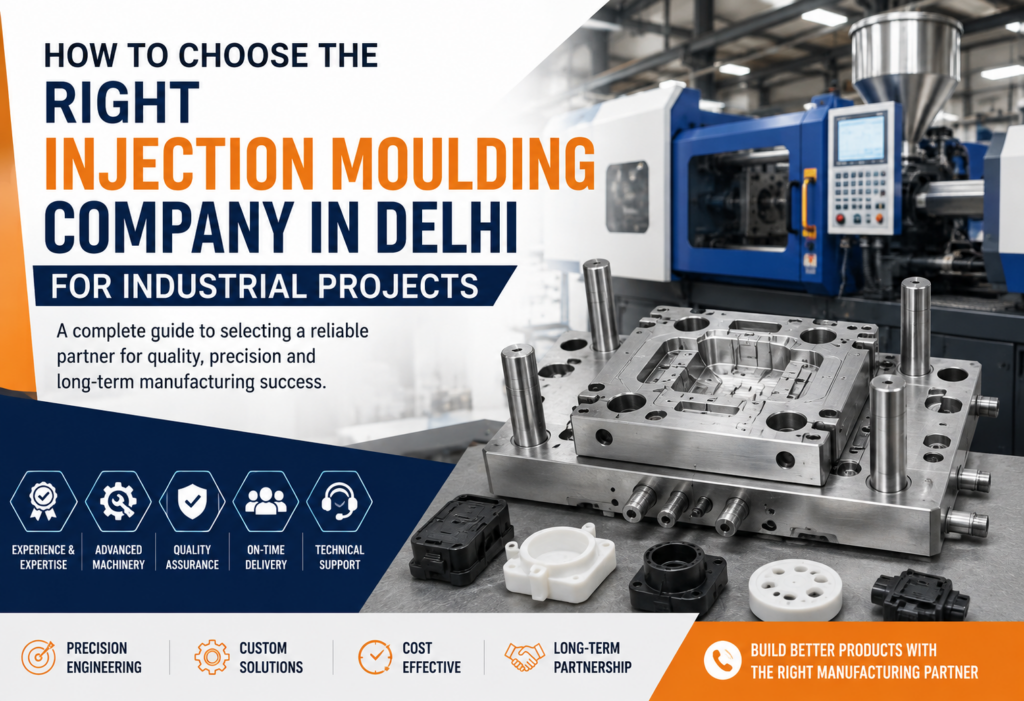
Choosing the right injection moulding company in Delhi is essential for industrial projects because it directly affects product quality, tooling life, delivery schedules, and manufacturing cost. The best supplier should have proven technical expertise, modern machinery, strong quality control, in-house tooling support, and the ability to handle your required production volume while providing reliable communication and after-sales support. Injection moulding is one of the most widely used manufacturing processes for producing plastic components in automotive, electrical, medical, consumer goods, and industrial sectors. Delhi and the NCR region host many moulding companies, but not every supplier is suitable for precision industrial applications. Selecting a capable manufacturing partner is a strategic decision that can reduce defects, shorten lead times, and improve long-term profitability. This guide explains the most important factors to evaluate before finalizing an injection moulding company for your industrial project. Why Supplier Selection Matters A moulding supplier influences: A poor supplier may initially appear economical, but repeated quality issues, mould repairs, production delays, and rejected parts can significantly increase total project cost. Understand Your Project Requirements First Before approaching any company, define your requirements clearly. Key details to prepare A technically detailed inquiry helps suppliers provide accurate quotations and manufacturing recommendations. Evaluate Industry Experience Choose a company that has experience in your specific industry. Industry-specific expertise matters Ask for similar project references, sample parts, or case studies. Check In-House Tooling Capability An industrial moulding partner should ideally offer in-house mould design and tool-room facilities. Benefits of in-house tooling Ask whether they provide: Assess Manufacturing Infrastructure Modern machinery improves consistency and productivity. What to check A company with a wide machine range can handle both small precision parts and large industrial components. Verify Quality Control Systems Quality assurance is critical for industrial applications. Important quality checkpoints Ask whether the company is certified to standards such as ISO 9001 or industry-specific certifications. Review Material Expertise Different applications require different engineering plastics. A capable supplier should guide you on Technical material support is a strong indicator of engineering capability. Examine Sample Parts and Tooling Quality Request sample components or visit the facility. Inspect for Consistent sample quality usually reflects process control maturity. Evaluate Production Capacity Ensure the supplier can meet your demand during peak periods. Ask about For OEM projects, scalable capacity is extremely important. Compare Total Cost, Not Just Unit Price The lowest quotation is not always the best choice. Consider total ownership cost A slightly higher-quality supplier may reduce long-term manufacturing expenses. Check Communication and Technical Support Effective communication prevents costly mistakes. A reliable supplier should provide Poor communication is one of the most common causes of project delays. Visit the Manufacturing Facility A factory audit provides valuable insights. During the visit observe Physical verification is often more informative than brochures or websites. Ask About Lead Times Industrial projects usually run on strict schedules. Clarify Written timelines should be part of the commercial agreement. Evaluate Long-Term Partnership Potential Choose a company that can grow with your business. Look for Long-term manufacturing partnerships generally deliver better cost and quality outcomes. Red Flags to Avoid Be cautious if a supplier: Suggested Supplier Evaluation Checklist Evaluation Area Check Industry experience ✓ In-house tooling ✓ Modern machinery ✓ ISO certification ✓ Quality inspection system ✓ Engineering support ✓ Production capacity ✓ Sample quality ✓ Delivery reliability ✓ Technical communication ✓ Use this checklist to compare multiple suppliers objectively. Why Delhi Is a Strong Manufacturing Hub Delhi-NCR offers several advantages for industrial moulding projects: These factors can reduce lead times and improve supply-chain efficiency. Selecting the right injection moulding company in Delhi is not just a procurement activity; it is an engineering and business decision. Focus on technical capability, tooling strength, quality systems, production capacity, and communication rather than only price. A well-qualified manufacturing partner can improve product quality, reduce production risks, and support future business growth. For industrial projects requiring precision moulds, reliable production, and engineering support, work with a company that demonstrates proven manufacturing expertise, transparent processes, and a commitment to long-term partnership. Frequently Asked Questions (FAQs) 1. What is the most important factor when choosing an injection moulding company in Delhi? The most important factor is technical capability, including tooling expertise, process control, quality systems, and experience with similar industrial components. 2. Should I choose a company with in-house mould manufacturing? Yes. In-house mould manufacturing usually provides faster development, easier modifications, better maintenance, and improved coordination between tooling and production teams. 3. How can I verify the quality of an injection moulding supplier? Request sample parts, inspection reports, certification details, customer references, and conduct a factory visit to evaluate machinery, inspection facilities, and process control. 4. Is ISO certification necessary for industrial projects? ISO certification is highly recommended because it indicates a structured quality management system, documented processes, and better traceability. 5. What information should I provide when requesting a quotation? Provide part drawings, material specification, annual quantity, tolerance requirements, surface finish requirements, color, assembly details, and packaging requirements. 6. How do I compare quotations from different moulding companies? Compare tooling cost, part price, mould life, quality standards, lead time, inspection support, packaging, logistics, and after-sales service rather than unit price alone. 7. Why is production capacity important? Adequate production capacity ensures timely delivery, scalability for future orders, and reduced risk of supply interruptions during demand fluctuations. 8. Can an injection moulding company help improve my product design? Yes. Experienced companies provide Design for Manufacturing (DFM) feedback to improve mouldability, reduce cost, improve cycle time, and enhance product performance.
Top Reasons Businesses Trust Expert Injection Mold Manufacturer
In today’s competitive manufacturing environment, businesses require high-quality, cost-effective, and scalable production solutions to meet customer demands. Injection moulding has become one of the most trusted manufacturing processes for producing precision plastic components across industries such as automotive, electronics, healthcare, consumer goods, and industrial equipment. Expert injection mold Manufacturer provide the perfect combination of quality, consistency, speed, and affordability. By partnering with experienced professionals, businesses can achieve superior product performance while reducing production costs and time-to-market. This is why companies around the world continue to rely on expert injection moulding partners for their manufacturing needs. Why Businesses Prefer Professional Injection Moulding Services Injection moulding is more than simply manufacturing plastic parts. It involves engineering expertise, advanced machinery, quality control systems, and process optimization to ensure exceptional results. 1. High Precision and Accuracy Expert injection moulding companies use advanced technology and precision tooling to manufacture components with tight tolerances and consistent dimensions. Benefits include: This level of precision is essential for industries where even minor dimensional variations can impact product functionality. 2. Cost-Effective Mass Production One of the biggest advantages of injection moulding is its ability to produce large quantities of parts efficiently. Professional injection moulding services help businesses: Once the mould is developed, thousands or even millions of identical parts can be manufactured with minimal variation. 3. Superior Product Consistency Consistency is critical for maintaining brand reputation and customer satisfaction. Expert manufacturers ensure: This consistency helps businesses maintain high-quality standards across every production batch. 4. Access to Advanced Technology Professional injection moulding companies invest in modern equipment and innovative manufacturing techniques. These technologies include: Advanced technology enables faster production cycles and improved product reliability. 5. Custom Design and Engineering Support Expert injection moulding providers often offer comprehensive design assistance from concept to final production. Engineering support includes: This expertise helps businesses create products that are both functional and cost-efficient. 6. Wide Range of Material Options Professional moulding companies have experience working with numerous thermoplastics and engineering-grade materials. Popular materials include: Choosing the right material improves durability, flexibility, chemical resistance, and overall product performance. 7. Faster Time-to-Market In modern industries, launching products quickly can create a significant competitive advantage. Expert injection moulding services accelerate product development through: This enables businesses to respond quickly to market opportunities and customer demands. 8. Enhanced Quality Control Leading injection moulding companies follow strict quality assurance procedures throughout the production cycle. Quality control measures may include: Strong quality management systems help minimize defects and ensure customer satisfaction. 9. Scalability for Growing Businesses Whether a company requires a small production run or millions of components annually, expert injection moulding services can easily scale production capacity. Advantages include: This scalability supports business growth without compromising quality. 10. Reliable Long-Term Partnership Businesses often view expert injection moulding providers as strategic manufacturing partners rather than simple suppliers. A trusted moulding partner offers: Long-term partnerships help businesses reduce risks and maintain uninterrupted production. Industries That Benefit from Injection Moulding Services Expert injection moulding solutions are widely used across various sectors: Automotive Industry Medical Industry Consumer Products Industrial Applications Electronics Industry Choosing the Right Injection Moulding Partner When selecting an injection moulding company, businesses should consider: A reliable manufacturing partner can significantly improve product quality, reduce costs, and enhance business efficiency. Expert injection moulding services play a crucial role in helping businesses achieve high-quality, cost-effective, and scalable manufacturing solutions. From precision engineering and material expertise to advanced technology and quality assurance, professional moulding providers deliver the consistency and reliability that modern industries demand. By partnering with an experienced injection moulding company, businesses can improve product performance, accelerate production timelines, and gain a competitive advantage in the marketplace. Looking for a trusted partner for your plastic manufacturing needs? Ankom Enterprises provides precision injection moulding solutions, mould design expertise, and high-quality plastic component manufacturing tailored to your industry requirements. Contact our team today to discuss your project and receive a customized quote.
What Are CNC Milling Services? A Complete Guide for Manufacturers
In today’s competitive manufacturing landscape, precision, efficiency, and consistency are critical to success. CNC milling services play a vital role in helping manufacturers produce complex parts with high accuracy and repeatability. Whether you are in automotive, aerospace, medical, or consumer goods, CNC milling has become an essential process for delivering quality components at scale. This guide explores everything manufacturers need to know about CNC milling, from its process and benefits to applications and how to choose the right service provider. What Are CNC Milling Services? CNC (Computer Numerical Control) milling is a subtractive manufacturing process that uses computer-controlled machines to remove material from a solid workpiece. The process involves rotating cutting tools that shape the material into the desired design based on pre-programmed instructions. Unlike traditional manual machining, CNC milling offers: Manufacturers rely on CNC milling to create parts with tight tolerances and complex geometries that would be difficult or impossible to achieve manually. How CNC Milling Works The CNC milling process involves several key steps to transform raw material into a finished component: 1. Design Creation Engineers create a CAD (Computer-Aided Design) model of the part, defining its dimensions, features, and specifications. 2. Programming The CAD file is converted into CAM (Computer-Aided Manufacturing) instructions, which guide the CNC machine on tool paths and cutting operations. 3. Machine Setup The operator secures the workpiece and selects the appropriate cutting tools based on the material and design requirements. 4. Milling Operation The CNC machine executes the programmed instructions, removing material layer by layer to form the final product. 5. Finishing and Inspection After machining, the part may undergo finishing processes such as polishing or coating, followed by quality inspection to ensure accuracy. Types of CNC Milling Machines Different types of CNC milling machines are used depending on the complexity and scale of production: Benefits of CNC Milling in Manufacturing The growing demand for precision engineering has made CNC milling services indispensable across industries. Here are some key advantages: High Precision and Accuracy CNC machines can achieve extremely tight tolerances, ensuring consistent quality in every part. Increased Productivity Automation allows for faster production with minimal downtime, improving overall efficiency. Versatility CNC milling can work with a wide range of materials, including: Cost-Effectiveness While the initial setup may require investment, CNC milling reduces labor costs and material waste over time. Repeatability Once programmed, CNC machines can produce identical parts in large quantities without variation. Applications of CNC Milling CNC milling is widely used across multiple industries due to its flexibility and precision: Automotive Industry Aerospace Industry Medical Industry Electronics Industry Industrial Manufacturing Materials Used in CNC Milling Choosing the right material is crucial for achieving desired performance and durability. Common materials include: Each material requires specific tooling and machining parameters to ensure optimal results. Key Considerations When Choosing CNC Milling Services Selecting the right service provider can significantly impact product quality and production efficiency. Here are some important factors to consider: Experience and Expertise Look for a provider with proven experience in your industry and the ability to handle complex projects. Technology and Equipment Advanced CNC machines, including multi-axis systems, ensure better precision and faster turnaround. Quality Assurance Ensure the company follows strict quality control measures and industry standards. Customization Capabilities A reliable partner should offer tailored solutions based on your design and production requirements. Turnaround Time Timely delivery is critical in maintaining your production schedule and meeting market demands. Future Trends in CNC Milling The future of CNC milling is driven by innovation and technological advancements: These trends are shaping the next generation of manufacturing, making CNC milling even more efficient and reliable. Why Manufacturers Prefer CNC Milling Service Manufacturers choose CNC milling because it combines precision, speed, and scalability. It enables businesses to: By leveraging modern CNC technology, companies can meet evolving customer demands while maintaining cost efficiency. As industries continue to evolve, the demand for precision manufacturing solutions is only increasing. CNC milling services provide manufacturers with the tools and capabilities needed to produce high-quality components efficiently and consistently. From design flexibility to advanced automation, CNC milling remains a cornerstone of modern manufacturing. Looking to enhance your manufacturing process with precision-engineered components? Partner with experts who understand your requirements and deliver reliable results. Get in touch today to explore customized CNC milling solutions tailored to your business needs and take your production capabilities to the next level.